
When commitment becomes a performance
Some people do not simply work hard.
They make sure everyone can see them working hard.
They volunteer first.
Push the team to aim higher.
Talk about what we should be doing.
Step in when something is not getting done.
And somehow, in almost every conversation, the same message begins to emerge:
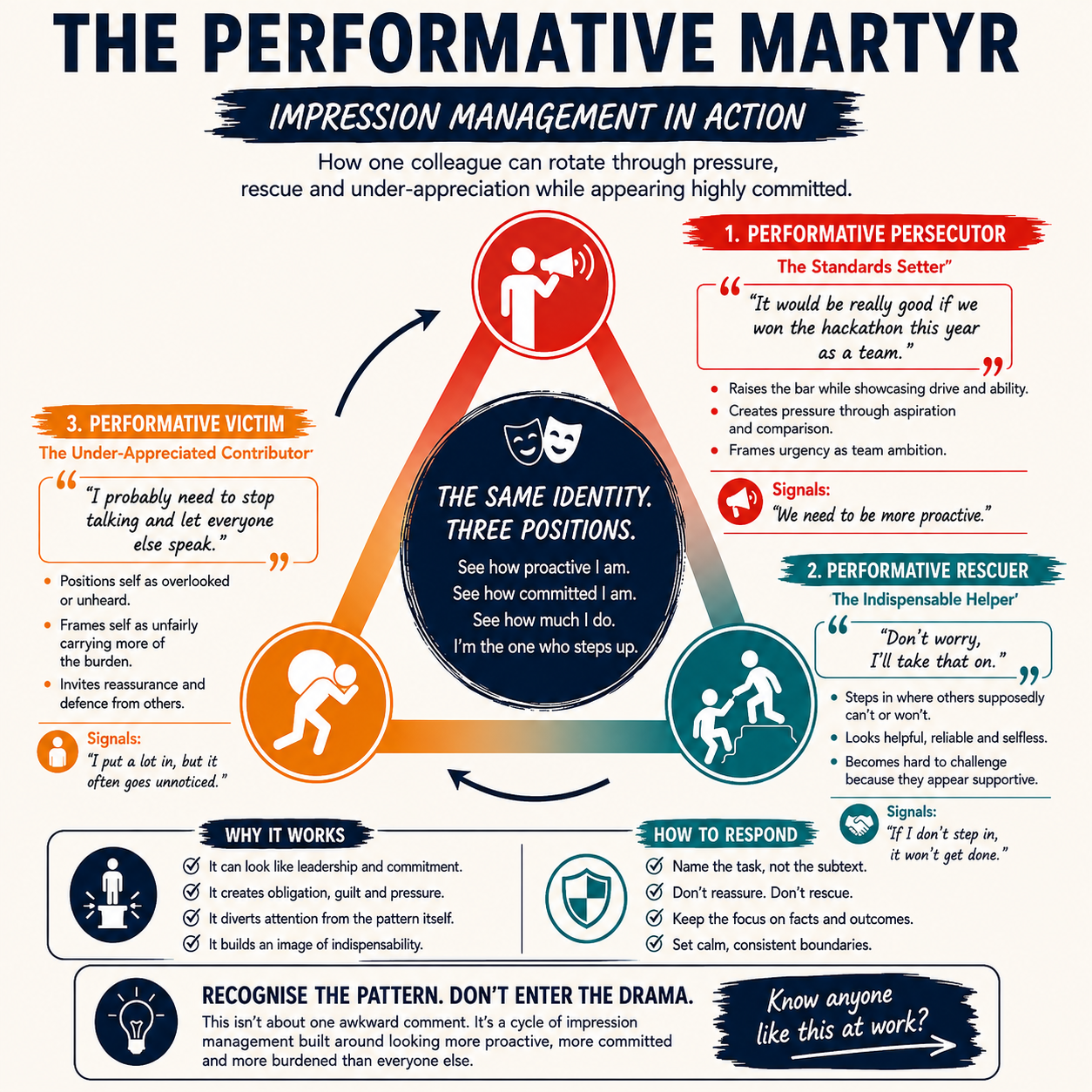
I am proactive.
I am committed.
I am the one who steps up.
Sometimes this can become a kind of impression management.
The person moves between different positions.
The standards setter:
“It would be really good if we won the hackathon this year as a team.”
It sounds positive.
But suddenly there is a standard in the room.
Enthusiasm becomes something to demonstrate.
Then the rescuer:
“Don’t worry, I’ll take that on.”
Helpful.
Reliable.
Indispensable.
Until helping also becomes evidence of how much more they appear to be doing.
And then, when the response they want does not arrive:
“I probably need to stop talking and let everyone else speak.”
Now the atmosphere changes.
Someone may reassure them.
Someone may explain.
Someone may feel guilty.
And an ordinary meeting becomes something else entirely.
The difficulty is that none of these moments necessarily looks unreasonable on its own.
That is what can make the pattern so confusing.
The pressure is rarely explicit.
The criticism may never quite be spoken.
The performance may look remarkably like commitment.
Yet over time, colleagues can find themselves measuring their own contribution against someone who is constantly displaying theirs.
Relational Space Therapy can offer a place to explore what happens when workplace relationships begin to feel psychologically complicated — particularly when what is being communicated is not always contained in the words being spoken.